Lake Bohinj is the largest natural lake in Slovenia, lying in a glacial valley within Triglav National Park in the Gorenjska region. It is surrounded by the peaks of the Julian Alps and is known for its clear water and quieter shores than nearby Bled. A level path runs along much of the shoreline, and the Church of St John the Baptist stands by the stone bridge at Ribčev Laz on the eastern end.
When to go
Best in summer
Lakes, high viewpoints and everything above 1,500 m: the mountain roads and huts open in June and the alpine lakes are at their bluest in July and August.
Seasons are a rule of thumb from the type of place and its elevation unless the owner has set them by hand.
Lake
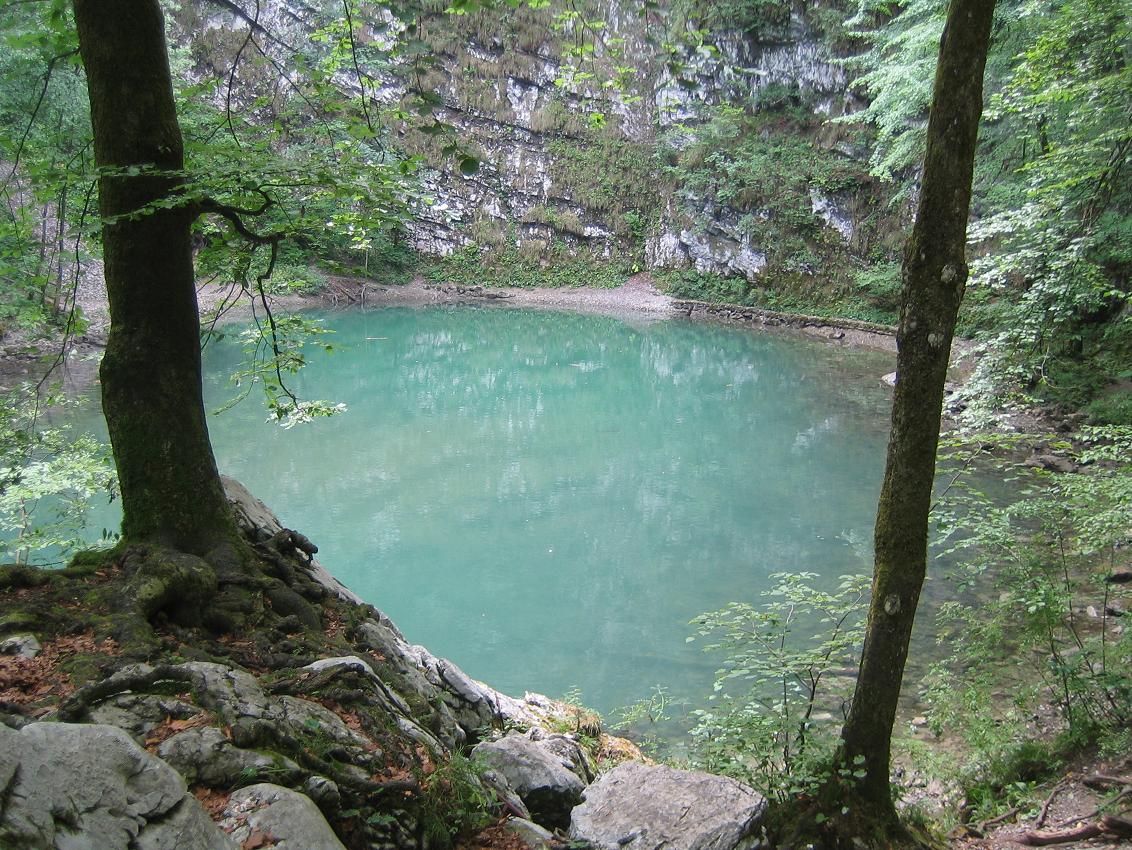
All of this kindWild Lake (Divje jezero) is a small lake fed by a karst spring that rises from a deep underwater shaft at the foot of a steep forested cliff. After heavy rain the water can surge up and spill into the short Jezernica stream, one of the shortest rivers in Slovenia. It lies just outside Idrija in western Slovenia and is reached by an easy walk.
Lake Trboje is a reservoir on the Sava River in the Gorenjska region, formed behind the hydroelectric dam near the village of Trboje. Its quiet banks suit an easy walk or a spot of birdwatching. The lake lies a short drive from Kranj and Medvode.
Lake Cerknica is an intermittent karst lake in the Primorsko-notranjska region, near the town of Cerknica. Depending on the season and rainfall, it fills into one of the largest lakes in Slovenia or drains away through underground karst channels, leaving meadows and fields. The flat surroundings suit easy walks and cycling along the shore and across the lake basin.
Lake Ptuj is a hydroelectric reservoir on the Drava River just upstream of Ptuj, in the Podravska region of northeastern Slovenia. Its open water and flat shores make it a calm place for a walk or bike ride along the embankments, with views back toward the old town. It is easy to combine with a visit to Ptuj itself.
Lake Palčje (Palško jezero) is an intermittent karst lake in the Primorsko-notranjska region, near the village of Palčje in the Pivka area. Depending on the season and rainfall, it can appear as open water or disappear entirely, leaving a grassy basin. It is a quiet spot for a short walk through the karst landscape, best visited after wet periods if you want to see it filled.
Black Lake (Črno jezero) is the lowest of the lakes in the Triglav Lakes Valley, set in forest within Triglav National Park in the Gorenjska region. Its dark, still water surrounded by trees and rock walls makes it a quiet stop on the way into the high valley. It is reached on foot by a steep mountain trail, most commonly climbed from the Bohinj side.
Lake Družmirje is an artificial lake in the Savinjska region, close to Šoštanj in the Šalek Valley. It formed as the ground subsided above coal mining, and its open water and level shoreline make it a quiet stop for an easy walk. The lakes of the valley lie between Šoštanj and Velenje, so it combines well with a visit to either town.
Cave
All of this kindPotok Cave (Potočka zijalka) is a high mountain cave on the slopes of Olševa in the Karawanks, in the Savinjska region near Solčava. It is one of the best-known Palaeolithic sites in Slovenia, where excavations uncovered cave bear remains and bone tools left by Ice Age hunters. Reaching it is a mountain hike, so plan for a proper walk on marked trails rather than a short stroll.
Postojna Cave is a large karst cave system on the edge of the town of Postojna in the Primorsko-notranjska region. Visitors travel deep into the cave by a small underground train before continuing on foot past halls of stalactites and stalagmites, and the cave is also known as home to the olm, the blind cave salamander. It is an easy day trip from Ljubljana, and the visit is a guided underground walk on paved paths.
Škocjan Caves are a cave system in the Karst of the Obalno-kraška region, where the Reka river disappears underground and flows through a deep canyon inside the cave. The system is a UNESCO World Heritage Site, known for its vast underground chambers and the bridge high above the river. The caves lie near Divača and are visited on guided tours.
Škocjan Caves are a karst cave system in the Kras region of southwestern Slovenia, where the Reka River disappears underground. The system is listed as a UNESCO World Heritage Site and is known for its vast underground canyon, crossed by a bridge high above the river. The caves lie near Divača, between Postojna and the coast.
This entry marks a cave near Kostanjevica na Krki, the small town in the Posavje region known for its old centre on an island in the Krka River. The karst cave lies at the edge of the hills just outside town and is a natural stop to pair with a stroll around the riverside centre. Base yourself in Kostanjevica na Krki in the lower Krka valley and reach the cave on a short trip from town.
Cross Cave (Križna jama) is a karst cave in the Primorsko-notranjska region of Slovenia, known for its chain of underground lakes and its rich cave fauna. It is one of the country's best-known caves and is visited in small guided groups rather than on paved walkways. The cave lies on the karst uplands near the Lož Valley, a short drive from Cerknica Lake.
Vilenica is a karst cave on the Karst plateau in southwestern Slovenia, near the village of Lokev not far from Sežana. It is widely regarded as one of the oldest show caves in Europe, with large halls decorated by dripstone formations. It makes an easy addition to a day exploring the Karst region and its villages.
Divje babe is a cave in the Goriška region of western Slovenia, set above the Idrijca valley. It is known as an archaeological site where Neanderthal-era finds were made, including a perforated bone often discussed as a possible flute. Expect a short uphill walk on a forest path to reach the cave entrance.
Castle
All of this kindCenter odpora 1 is a former military fortification at Bogatinsko sedlo, a mountain pass in the Julian Alps in the Goriška region. The remains of the defensive position give a sense of how this high crossing was guarded, set among open alpine terrain. Reaching it means a mountain hike, so plan for a full day on foot with proper footwear.
Center odpora 2 is the site of a former military strongpoint on Bogatinsko sedlo, a high mountain saddle in the Julian Alps in the Goriška region. Its name, meaning resistance centre, reflects the defensive role this border ridge once had, and the remains sit in open alpine terrain. Reaching it means a proper mountain hike, so plan for high-altitude trails and changeable weather.
Center odpora 3 is a former military fortification at Bogatinsko sedlo, a mountain pass in the Goriška region of the Julian Alps. Its remains offer a look at the defensive structures built in this high, rugged terrain. Reaching it means a mountain hike, so come prepared with proper footwear and check the weather before setting out.
Bogatinsko sedlo – Center odpora 4 is a former military fortification at the Bogatin saddle, a high mountain pass in the Goriška region of the Julian Alps. The remains of the defensive position sit in open alpine terrain and give a sense of how these passes were guarded. Reaching it is a mountain hike rather than a short stroll, so come prepared for high-altitude paths.
Predjama Castle is a medieval fortress built into the mouth of a cave halfway up a sheer cliff face. Its setting, with the castle walls merging into the rock and a cave system behind them, makes it one of the most recognisable sights in Slovenia. It lies in the Primorsko-notranjska region, a short drive from Postojna, and is often combined with a visit to Postojna Cave.
Ljubljana Castle is the medieval fortress on the hill above the old town of Ljubljana, in central Slovenia. From its walls and lookout tower there are wide views over the capital's rooftops and, on clear days, toward the Alps. The castle can be reached on foot by paths from the old town or by the funicular railway.
Bled Castle is a medieval castle standing on a steep cliff above Lake Bled in the Gorenjska region. From its terraces there is a wide view over the lake, the island church and the surrounding Julian Alps. The castle sits directly above the town of Bled and can be reached on foot by a short but steep path from the lakeshore.
Maribor Castle is a castle in the centre of Maribor, Slovenia's second-largest city, in the Podravska region of the northeast. It stands at the edge of the old town and houses the regional museum, making it an easy stop on a walk through the city streets.
Viewpoint
All of this kindKojca is a mountain in the Goriška region of western Slovenia, listed here as a viewpoint. From its summit you look out over the surrounding hills and valleys of the area. Reaching it means a hike on mountain paths, so plan for a proper walk rather than a short stroll.
Viševnik is a mountain summit in the Julian Alps above the Pokljuka plateau in the Gorenjska region, used as a viewpoint over the surrounding peaks. From the top the view opens toward Triglav and the high ridges of the Julian Alps. It is reached on a mountain hike, so plan for a proper ascent with suitable footwear.
Črna Prst is a mountain in the Julian Alps in the Gorenjska region, valued as a viewpoint over the surrounding peaks and valleys. It sits on the southern edge of the range, above the Bohinj area. Reaching the top is a proper mountain hike, so plan for a full day on marked trails and suitable footwear.
Pleša is a viewpoint in the Primorsko-notranjska region of inner Slovenia, in the karst countryside around Postojna and Pivka. It is worth a stop for the open view over the surrounding hills, plateaus and valleys of Notranjska. Expect a short walk on rural paths, so sturdy shoes are a good idea.
Smokuški vrh is a hilltop viewpoint in the Gorenjska region, rising above the village of Smokuč between Žirovnica and Begunje na Gorenjskem. From the top you look out over the Upper Sava valley and the Karavanke foothills. It makes a short half-day hike on forest paths from the villages below.
A viewpoint overlooking Planina v Lazu, a high mountain pasture in the Julian Alps of the Gorenjska region. It offers a view over the alpine meadow and the surrounding peaks. The spot lies in the Triglav National Park area above Bohinj and is reached on foot by mountain trail.
Vogar is a viewpoint on the slopes above Lake Bohinj in the Gorenjska region, looking out over the lake and the surrounding mountains of the Julian Alps. It is reached on foot by a forest path climbing from the lake's eastern shore, a short but steady uphill walk suited to a half-day outing from Bohinj.


