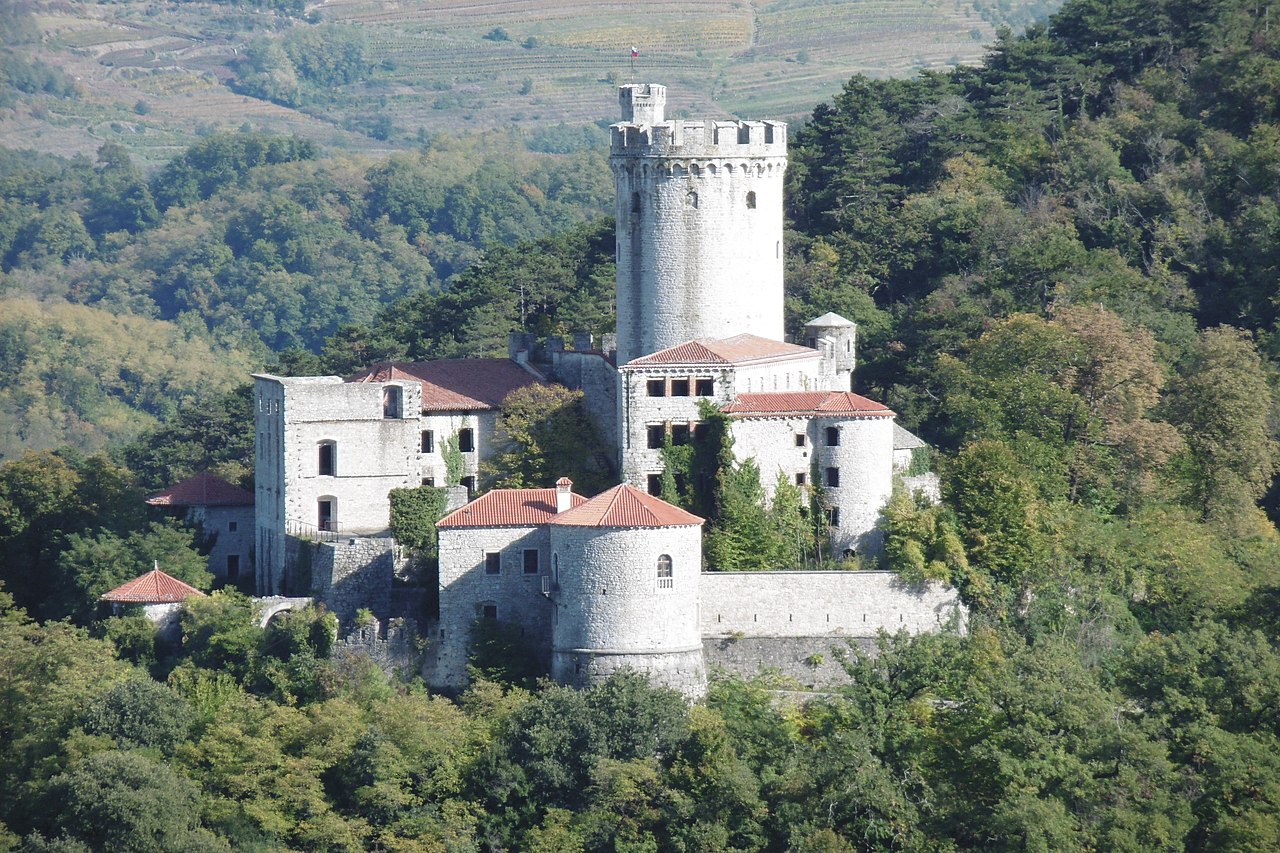
Predjama Castle is a medieval fortress built into the mouth of a cave halfway up a sheer cliff face. Its setting, with the castle walls merging into the rock and a cave system behind them, makes it one of the most recognisable sights in Slovenia. It lies in the Primorsko-notranjska region, a short drive from Postojna, and is often combined with a visit to Postojna Cave.
When to go
Good in winter
Show caves keep 10 °C all year and castles don't close — the year-round places, with the mountain roads left for summer.
Seasons are a rule of thumb from the type of place and its elevation unless the owner has set them by hand.
Castle
All of this kindLjubljana Castle is the medieval fortress on the hill above the old town of Ljubljana, in central Slovenia. From its walls and lookout tower there are wide views over the capital's rooftops and, on clear days, toward the Alps. The castle can be reached on foot by paths from the old town or by the funicular railway.
Bled Castle is a medieval castle standing on a steep cliff above Lake Bled in the Gorenjska region. From its terraces there is a wide view over the lake, the island church and the surrounding Julian Alps. The castle sits directly above the town of Bled and can be reached on foot by a short but steep path from the lakeshore.
Maribor Castle is a castle in the centre of Maribor, Slovenia's second-largest city, in the Podravska region of the northeast. It stands at the edge of the old town and houses the regional museum, making it an easy stop on a walk through the city streets.
Ptuj Castle stands on a hill above the old town of Ptuj, one of the oldest towns in Slovenia, in the Podravska region. It houses a regional museum, and the castle terraces look out over the red rooftops and the Drava River. The walk up from the town centre is short, along a cobbled lane.
Branik Castle, known in Slovenian as Grad Rihemberk, is a castle with origins in the 13th century, standing above the village of Branik in the Goriška region. Its walls and towers rise over the lower Vipava Valley, and the castle hill offers views across the surrounding countryside. It lies a short drive from Nova Gorica and can be combined with a walk around the village below.
Kieselstein Castle is a historic castle in the centre of Kranj, the main town of the Gorenjska region. Its compact building stands in the old town, which sits on a rocky spur above the Kokra and Sava rivers. It is easy to include in a stroll through Kranj's old streets on foot.
Kostel Castle is a castle ruin in southeastern Slovenia, standing on a hill above the Kolpa valley close to the Croatian border. The remains of its walls and towers give a sense of how the stronghold once watched over this border area. It lies in the Kostel area of the Kočevje region, a quiet stop for those exploring the Kolpa river.
Cave
All of this kindPostojna Cave is a large karst cave system on the edge of the town of Postojna in the Primorsko-notranjska region. Visitors travel deep into the cave by a small underground train before continuing on foot past halls of stalactites and stalagmites, and the cave is also known as home to the olm, the blind cave salamander. It is an easy day trip from Ljubljana, and the visit is a guided underground walk on paved paths.
Škocjan Caves are a karst cave system in the Kras region of southwestern Slovenia, where the Reka River disappears underground. The system is listed as a UNESCO World Heritage Site and is known for its vast underground canyon, crossed by a bridge high above the river. The caves lie near Divača, between Postojna and the coast.
Škocjan Caves are a cave system in the Karst of the Obalno-kraška region, where the Reka river disappears underground and flows through a deep canyon inside the cave. The system is a UNESCO World Heritage Site, known for its vast underground chambers and the bridge high above the river. The caves lie near Divača and are visited on guided tours.
This entry marks a cave near Kostanjevica na Krki, the small town in the Posavje region known for its old centre on an island in the Krka River. The karst cave lies at the edge of the hills just outside town and is a natural stop to pair with a stroll around the riverside centre. Base yourself in Kostanjevica na Krki in the lower Krka valley and reach the cave on a short trip from town.
Cross Cave (Križna jama) is a karst cave in the Primorsko-notranjska region of Slovenia, known for its chain of underground lakes and its rich cave fauna. It is one of the country's best-known caves and is visited in small guided groups rather than on paved walkways. The cave lies on the karst uplands near the Lož Valley, a short drive from Cerknica Lake.
Vilenica is a karst cave on the Karst plateau in southwestern Slovenia, near the village of Lokev not far from Sežana. It is widely regarded as one of the oldest show caves in Europe, with large halls decorated by dripstone formations. It makes an easy addition to a day exploring the Karst region and its villages.
Divje babe is a cave in the Goriška region of western Slovenia, set above the Idrijca valley. It is known as an archaeological site where Neanderthal-era finds were made, including a perforated bone often discussed as a possible flute. Expect a short uphill walk on a forest path to reach the cave entrance.
Pekel, known in English as Hell Cave, is a karst cave in the Savinjska region of eastern Slovenia, in the hills near Žalec. It is one of the few show caves in this part of the country and makes a short underground stop on a day out in the Lower Savinja Valley.